What RailCompute handled
From dataset to packaged model artifact.
The workflow handled dataset preparation, model-training planning, GPU-backed training, validation/test evaluation, and delivery of model files and documentation.
Proof run / Manufacturing vision
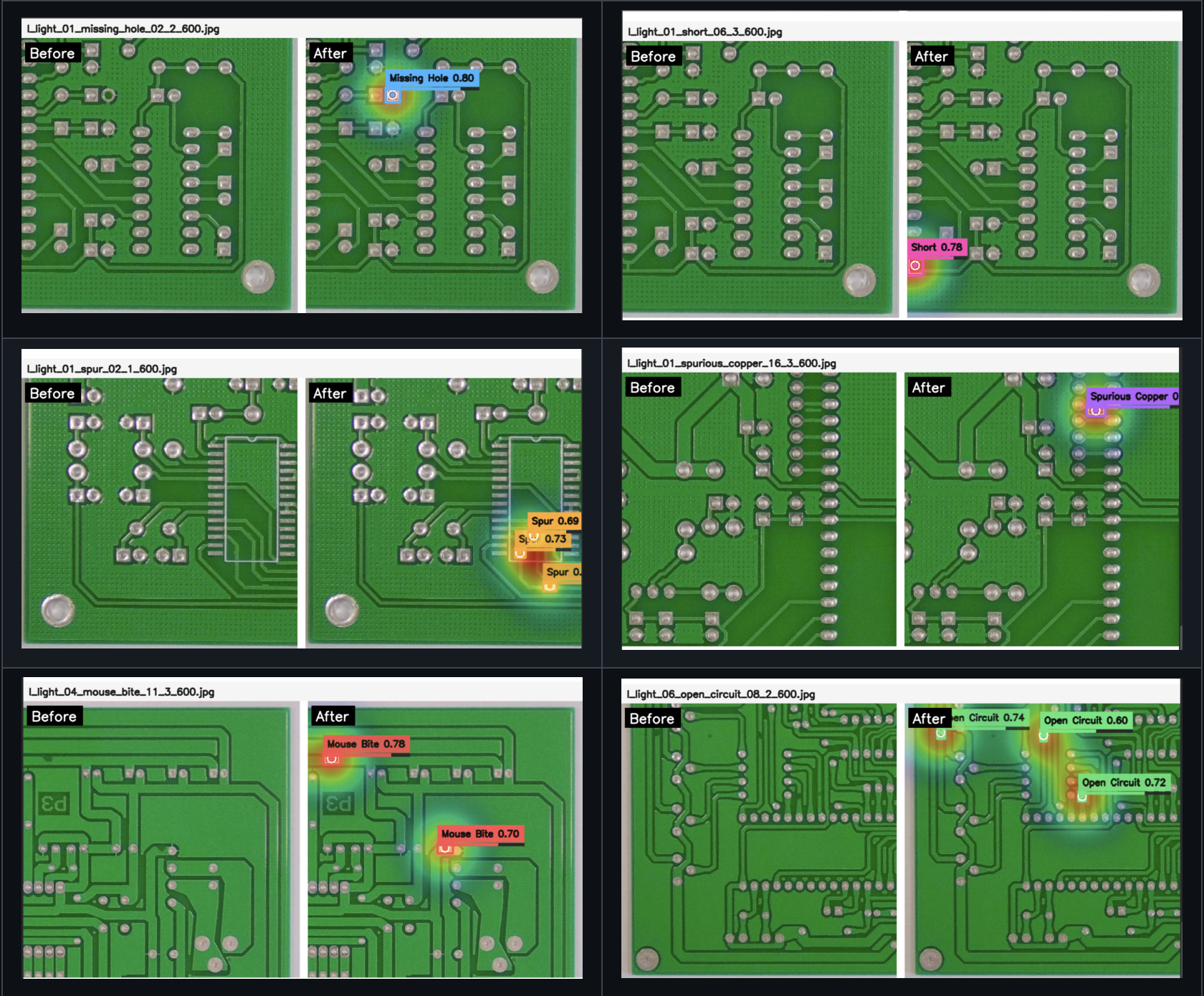
This run shows a practical six-class object detector packaged with weights, ONNX export, inference code, metrics, training notes, and output examples. It is a workflow demonstration, not a state-of-the-art benchmark claim.
Sample output
What RailCompute handled
The workflow handled dataset preparation, model-training planning, GPU-backed training, validation/test evaluation, and delivery of model files and documentation.
YOLO-format PCB inspection data, class mapping, validation/test split disclosure, and dataset attribution.
YOLO11n base model, 80 epochs, 640px image size, batch 16, seed 42, trained on an RTX A4000.
Final metrics, per-class localization notes, curves, confusion matrices, speed breakdown, and limitation notes.
Training setup
The run used a public six-class PCB defect dataset in YOLO object detection format. The repository includes PyTorch weights, ONNX export, an inference script, metrics JSON, training config, results CSV, and documentation.
Full training video
Artifacts
The GitHub repository includes the inference script, model card, dataset disclosure, checksums, weights, metrics, plots, and RailCompute training notes.
This proof run is an automated training showcase, not a production-certified quality-control system or SOTA benchmark submission. Validate on your own cameras, lighting, PCB types, defect definitions, and acceptance thresholds before operational use.